
AI IMAGE
In a significant judgment strengthening the rights of senior citizens, the Bombay High Court has ruled that property transferred by elderly parents on the assurance of care, support and residence can be reclaimed if those commitments are not honoured.
KHABAR 365 NEWS NETWORK
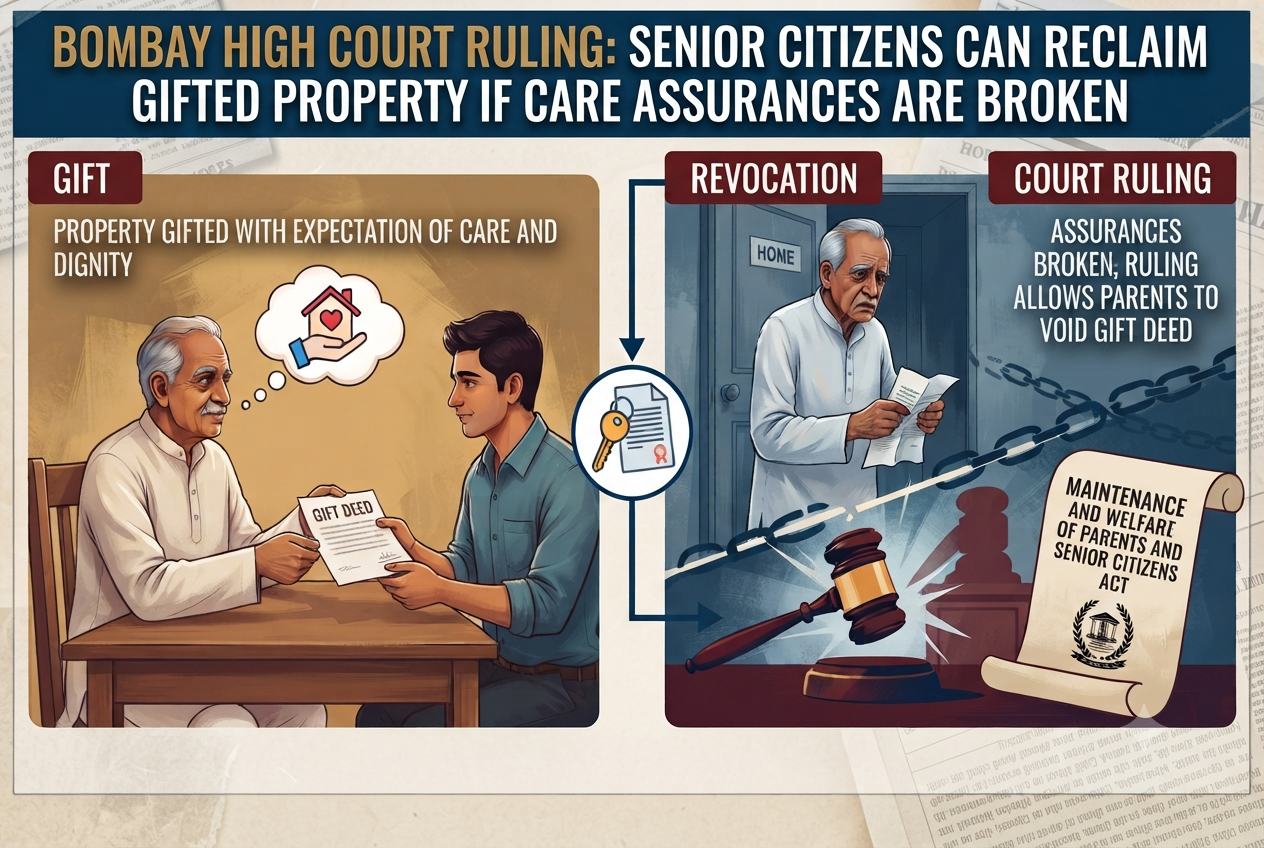
The Bombay High Court has delivered a significant ruling on the rights of senior citizens, holding that property gifted by elderly parents can be taken back when the transfer was made on the understanding that they would be cared for and allowed to live with dignity, but those assurances are later broken.
The judgment came in a case involving Devchand Korshi Dedhia, an elderly Mumbai resident who had transferred his residential flat to his son, Shiban Devchand Dedhia, through a registered gift deed. The transfer was made with the expectation that the father would continue to reside in the property and receive care and support during his lifetime.
According to the case, the relationship between the parties deteriorated after the transfer. The elderly father alleged that he was denied the benefit of the arrangement and was eventually forced to seek legal remedies under the Maintenance and Welfare of Parents and Senior Citizens Act, 2007.
After examining the facts, the High Court concluded that the transfer was not an unconditional gift. The court found that the father’s continued residence and welfare formed a fundamental part of the arrangement under which the property had been gifted. Since those conditions were not fulfilled, the court held that the gift deed could not be allowed to stand.
The High Court revoked the transfer and ordered restoration of the property to the elderly father. The order also directed compliance within the stipulated period and provided for enforcement measures, including eviction if necessary.
Residence Is Part of Maintenance
One of the most important aspects of the ruling is the court’s recognition that maintenance of senior citizens is not limited to financial support.
The judgment makes it clear that an elderly parent’s right to residence, security and dignified living forms an essential part of maintenance. A child who receives property from a parent cannot separate the benefits of ownership from the responsibilities that accompanied the transfer.
The court effectively held that when property is transferred in return for an assurance of care, that assurance becomes more than a moral obligation. It becomes a condition that can carry legal consequences.
Welfare Law Must Protect the Elderly
The judgment also highlights the protective purpose of the Maintenance and Welfare of Parents and Senior Citizens Act, 2007.
The court observed that the legislation was enacted to safeguard elderly persons from neglect, insecurity and vulnerability. Its provisions must therefore be interpreted in a manner that advances the welfare of senior citizens rather than frustrates the objective of the law.
The ruling reinforces the idea that elderly parents who transfer property to their children do not lose the protection of law merely because ownership has changed hands.
Why the Judgment Matters
The decision could have implications for thousands of families across India where ageing parents transfer homes, land or other assets to their children in the expectation of support during their later years.
As property-related disputes involving senior citizens become increasingly common, the judgment serves as a reminder that transfers made on the promise of care are not beyond scrutiny. Where that promise is broken, courts have the power to intervene and restore the rights of vulnerable parents.
For many senior citizens, the ruling strengthens an important legal safeguard: property given in expectation of care need not become a permanent loss if the care never materialises.
khabar 365 Takeaway
The Bombay High Court’s ruling goes beyond a single family dispute. It affirms that dignity, shelter and care are central to the rights of senior citizens. More importantly, it sends a clear message that children who receive property on the assurance of looking after ageing parents cannot retain the benefits of that transfer while abandoning the obligations that came with it.
Leave a Reply