
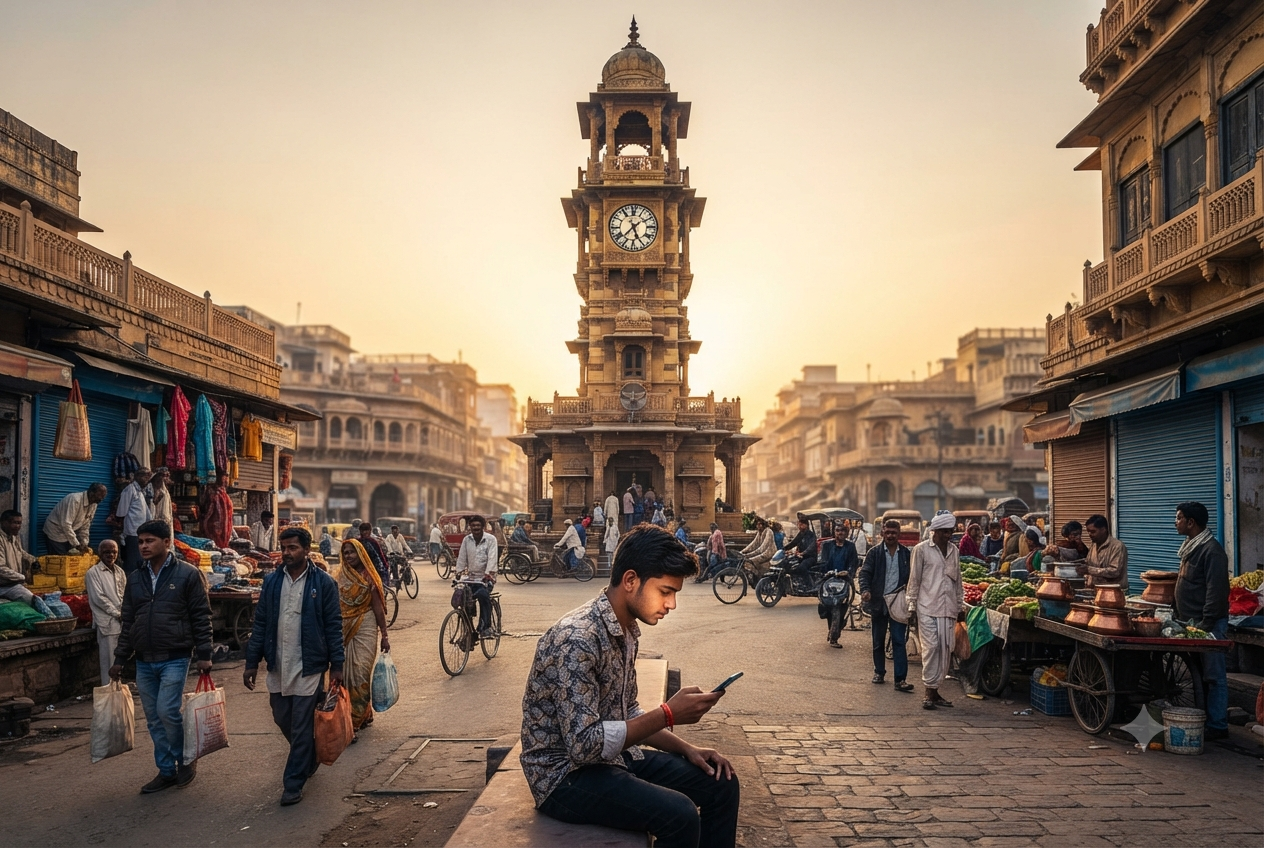
Before smartphones, smartwatches and Google, millions of Indians looked up to a clock tower or a public clock to answer a simple question: What time is it? Today, many of those once-essential landmarks stand silent, overlooked and frozen in time.
KHABAR365 CURIOSITIES DESK
Long before smartphones slipped into our pockets and digital assistants began answering questions in seconds, there was another tool that quietly guided daily life across India. It stood above crowded marketplaces, watched over railway stations and overlooked busy town squares.
It was the public clock.
For generations, these clocks were among the most important pieces of urban infrastructure. Shopkeepers opened their shutters by them. Students hurried to school because of them. Travellers rushed for trains after glancing up at them. In many towns, a single public clock told an entire community when to begin its day, when to break for lunch and when to head home.
In a way, the town clock was the Google of its time.
Need to know the time? Look up.
There was no internet connection, no battery and no app. Yet thousands of people depended on the same answer displayed on four giant clock faces visible from every direction.
When Time Belonged to the Town
Across India, clock towers became familiar landmarks. Some were built by municipal bodies, others by royal families, traders, philanthropists or colonial administrations. Beyond their practical purpose, they often became the centrepieces of growing towns.
People arranged meetings beneath them.
Bus conductors checked them before departure.
Vendors relied on them to judge the passing of the day.
In an era when wristwatches were expensive and household clocks were not universal, public clocks democratised time itself. Rich and poor looked at the same clock.
The town functioned to a common rhythm.
The Slow Disappearance
Then came personal watches.
Later came digital clocks.
Then mobile phones.
Today, almost every person carries multiple devices capable of displaying the time with second-by-second accuracy. Looking up has been replaced by looking down.
As technology became personal, public clocks gradually lost their importance.
Many continue to stand proudly atop old municipal buildings and market squares, but some have stopped working. Others display incorrect times. A few have disappeared altogether during urban redevelopment projects.
Ironically, many people pass these structures every day without noticing them.
What was once essential has become decorative.
More Than Just Clocks
Yet public clocks were never merely instruments for measuring time.
They were meeting places.
They were navigation points.
They were part of a town’s identity.
Ask an older resident about a famous clock tower and the conversation often turns into a story about school days, market visits, political rallies, festive gatherings or a first job.
The clock may have measured the hours, but it also witnessed lives unfolding beneath it.
The Value of Looking Up
The disappearance of public clocks reflects more than a technological shift. It reveals how our relationship with public spaces has changed.
Once, information was shared. Today, it is personalised.
Once, entire communities relied on common landmarks. Today, each individual carries a private screen.
The convenience is undeniable. Few would trade a smartphone for a clock tower.
Yet something has been lost in the process.
The public clock required people to engage with their surroundings. It connected them, however briefly, to a shared experience of place and time.
Timekeepers Worth Preserving
Many historic clock towers still survive across India’s cities and towns. They remain reminders of a period when public architecture served practical as well as symbolic purposes.
Restoring and preserving these structures is not merely about conserving old buildings. It is about protecting pieces of collective memory.
Their hands may no longer guide daily schedules, but they still tell an important story: how people once lived before every answer fit into the palm of a hand.
Khabar365 Takeaway
Technology has given us the ability to know the time anywhere, at any moment. Yet the old public clocks remind us of an era when communities shared the same reference point. Before smartphones, before search engines and before notifications, people simply looked up. And the town clock always had the answer.
Leave a Reply