
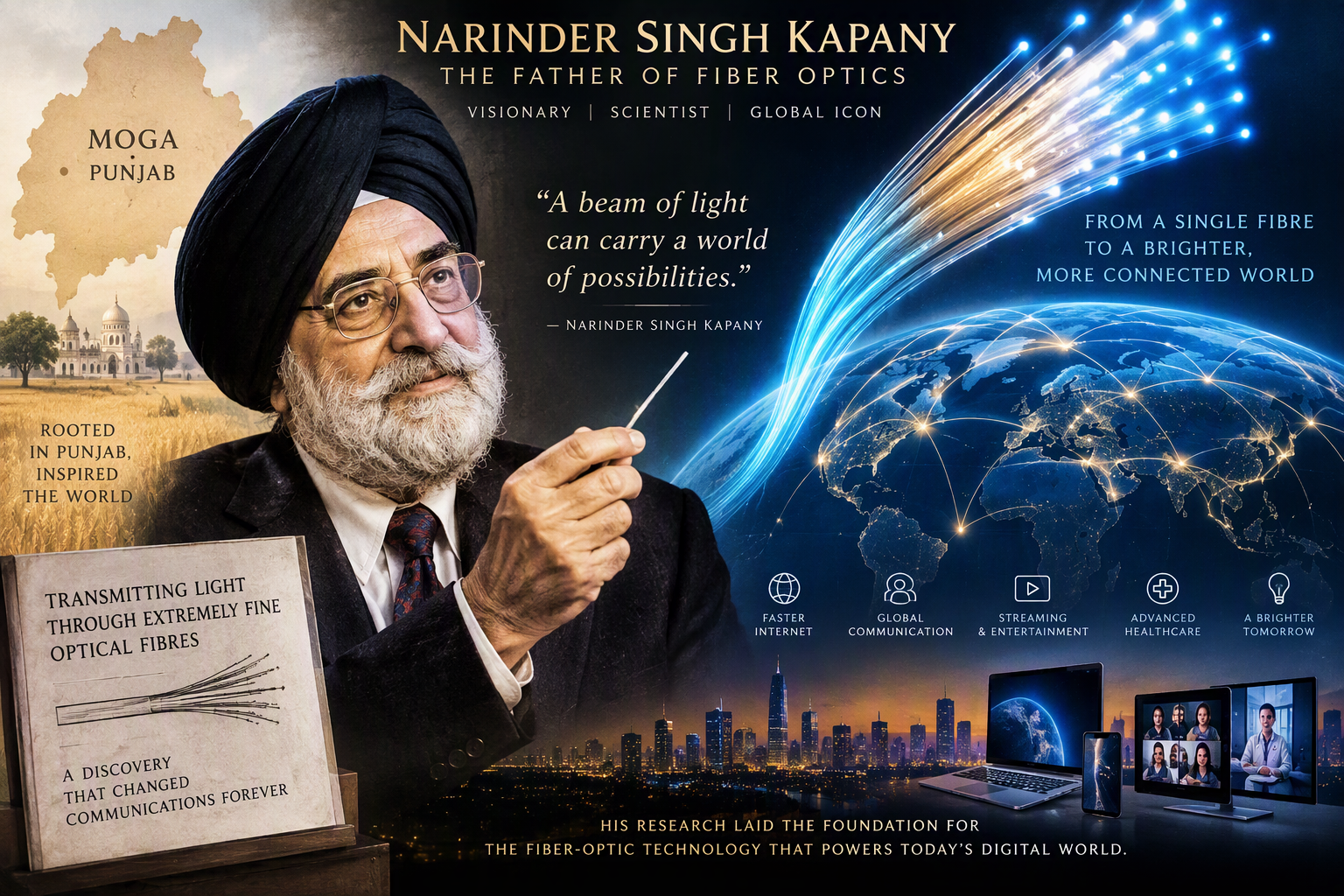
Without fiber-optic technology, the high-speed internet services that support video conferencing, digital payments, cloud computing and online learning would not exist in their present form. Much of this revolution traces its roots to the pioneering work of Narinder Singh Kapany.
khabar365 News network
Prime Minister Narendra Modi’s mention of Narinder Singh Kapany in the latest episode of Mann Ki Baat has renewed interest in the life and achievements of the scientist widely known as the “Father of Fiber Optics.” The Prime Minister paid tribute to Kapany ahead of his 100th birth anniversary on October 31 and urged young people to learn from his remarkable journey.
Born in Punjab’s Moga district, Narinder Singh Kapany earned global recognition for his pioneering work in transmitting light through extremely fine optical fibres. His research opened new possibilities in the field of communications and laid the foundation for the fiber-optic technology that powers today’s digital world.
Highlighting Kapany’s contribution, the Prime Minister noted that the modern era of the internet and digital communication would be difficult to imagine without fiber optics. The technology forms the backbone of high-speed internet networks, enabling everything from video calls and online banking to streaming services and global data transmission.
Often described as one of the most influential yet lesser-known scientists of Indian origin, Kapany’s work transformed a scientific concept into a technology that connects billions of people across the world every day. As the nation prepares to mark his 100th birth anniversary, the tribute in Mann Ki Baat serves as a reminder of the lasting impact of Indian scientific innovation on the modern world.
365 Takeaway
Millions use the internet every day, but few know the name of the scientist whose work helped make it possible. Narinder Singh Kapany’s legacy continues to connect the world through beams of light travelling across optical fibers.
Leave a Reply