
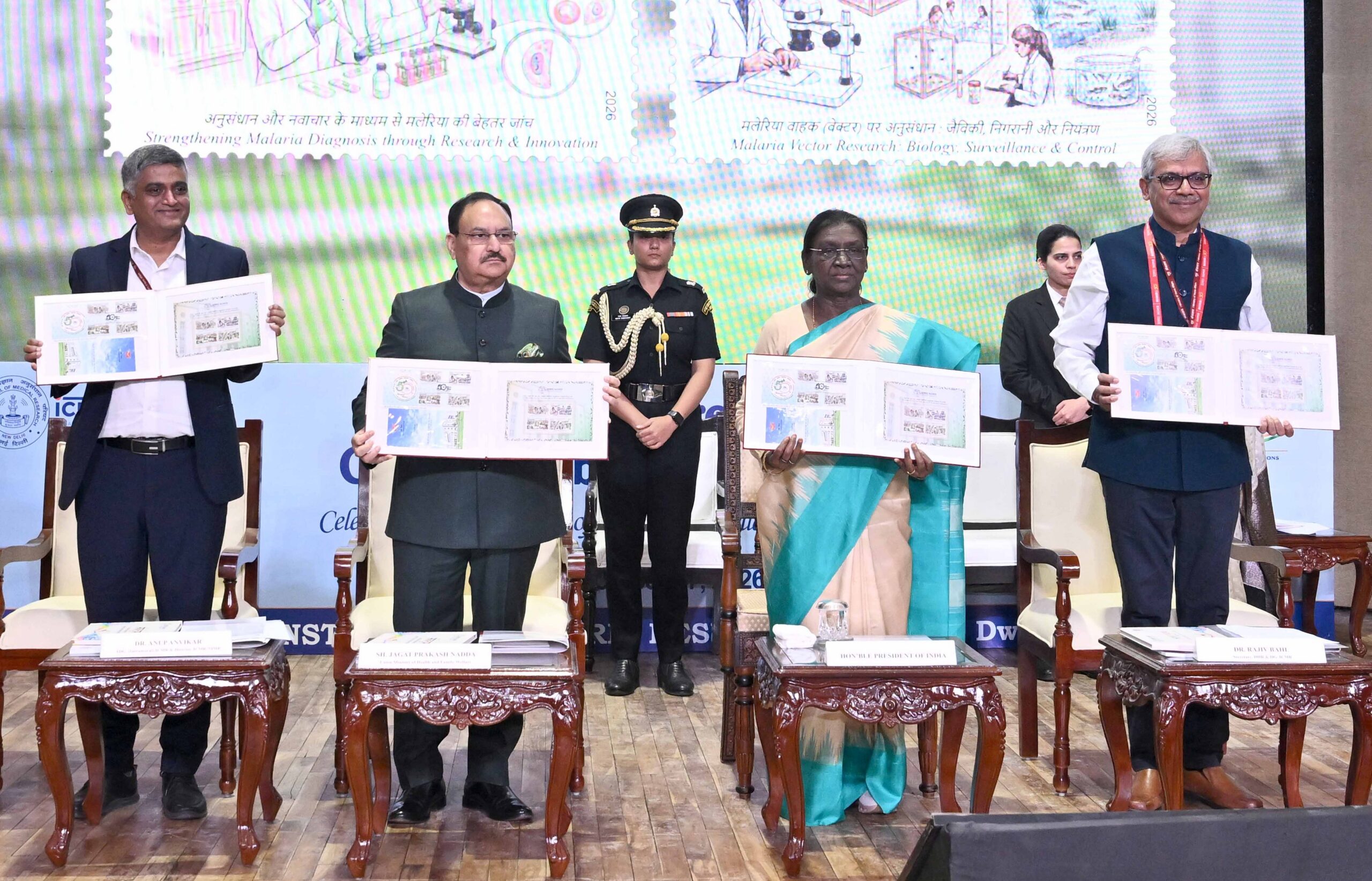
President Droupadi Murmu while inaugurating the Golden Jubilee celebrations of ICMR-NIMR.
“Institutions like ICMR can lead India’s journey towards the health goals of Viksit Bharat through research, collaboration and innovation,” said President Droupadi Murmu while inaugurating the Golden Jubilee celebrations of ICMR-NIMR.
KHABAR 365 NEWS NETWORK
New Delhi, November 17: President Droupadi Murmu on Tuesday inaugurated the year-long Golden Jubilee celebrations of the Indian Council of Medical Research-National Institute of Malaria Research (ICMR-NIMR), highlighting the institution’s role in India’s fight against malaria and its contribution to strengthening public health systems.
Addressing the gathering, the President said India has achieved significant progress in controlling malaria over the years through improved healthcare services, modern diagnostic techniques, effective medicines, mosquito-control initiatives and active community participation. She noted that the country’s efforts received global recognition when India moved out of the World Health Organization’s ‘High Burden to High Impact’ category in 2024.
The President lauded ICMR-NIMR for its five decades of pioneering research in malaria parasites, mosquito vectors, insecticide resistance and community-based disease surveillance. She said the institute has played a crucial role in supporting national efforts to reduce the burden of malaria and advancing scientific understanding of vector-borne diseases.
Highlighting emerging health concerns, Murmu cautioned that climate change, rapid urbanisation and growing insecticide resistance among mosquitoes could create new challenges in the eradication of malaria. She stressed the need for integrated measures such as environmental management, prevention of water stagnation and elimination of mosquito breeding sources alongside healthcare interventions.
Referring to the increasing incidence of dengue, the President said global warming and changing monsoon patterns may further intensify the threat posed by vector-borne diseases. She acknowledged the role played by ICMR in guiding India’s response to diseases such as tuberculosis, leprosy and kala-azar, and recalled its contribution during the COVID-19 pandemic, including the rapid expansion of testing facilities and support for the development of the country’s first indigenous COVID-19 vaccine.
Calling for stronger collaboration among research institutions, higher education centres and industry, the President said such partnerships are vital for building a healthy and empowered India. She expressed confidence that premier institutions like ICMR would help achieve the healthcare objectives of Viksit Bharat 2047 through continued innovation, scientific research and collaborative efforts.
Khabar 365 Takeaway
As India advances towards malaria elimination and broader public health goals, scientific research, innovation and institutional collaboration will remain key pillars in tackling both existing and emerging health challenges.
Leave a Reply