
By Bhavana Pandey
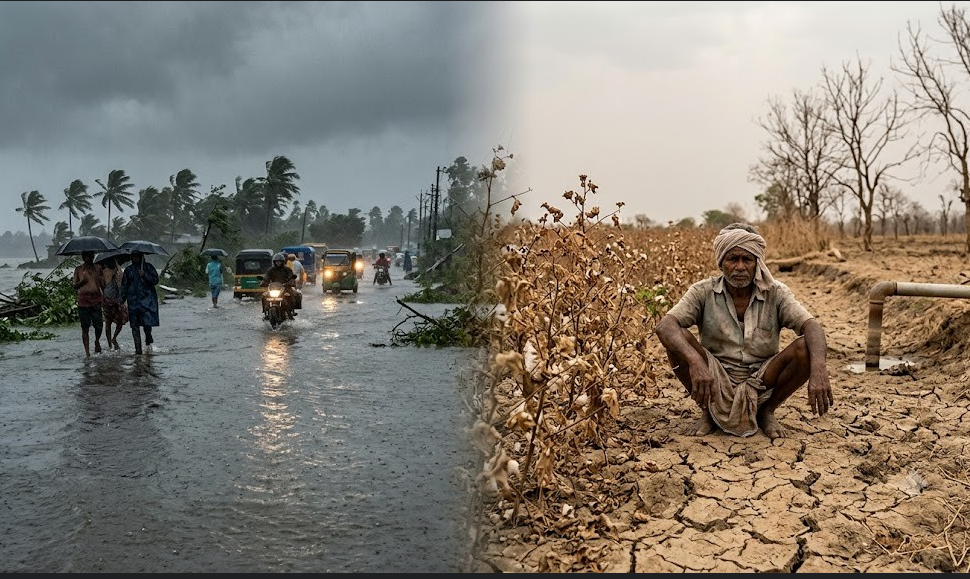
While Cyclone Arnab has brought heavy rain, strong winds and flooding concerns to eastern India, Telangana has been declared drought-hit. These contrasting developments underscore a deeper challenge facing the country: climate extremes are becoming more frequent, more unpredictable and more costly.
India today presents a striking contrast.
In the east, Cyclone Arnab has brought heavy rainfall, strong winds and widespread disruption. In Telangana, farmers and communities are grappling with drought conditions caused by inadequate rainfall and shrinking water resources. One region is struggling with excess water, while another faces an acute shortage.
At first glance, these appear to be unrelated events. In reality, they are connected by a larger trend that is becoming increasingly visible across the country.
For generations, India’s economy and society have been shaped by predictable seasonal cycles. Farmers planned sowing patterns around the monsoon. Reservoirs were managed using historical rainfall trends. Cities expanded on the assumption that weather would behave much as it had in the past.
That assumption no longer holds true.
Across India, weather is becoming increasingly erratic. Torrential rainfall can occur within a few hours, overwhelming drainage systems and causing floods. At the same time, prolonged dry spells can leave fields parched and reservoirs depleted. Increasingly, the challenge is not simply too much rain or too little rain, but where, when and how that rain falls.
The consequences go far beyond weather forecasts. Agriculture, water security, food production, public health and infrastructure are all affected. Farmers face uncertainty over crop planning. Cities struggle with waterlogging and traffic paralysis. Rural communities battle falling groundwater levels and crop losses.
The real concern is that extreme weather events are no longer isolated incidents. They are becoming part of a broader pattern.
India has made remarkable progress in disaster preparedness. Improved cyclone forecasting and evacuation systems have saved countless lives over the years. However, disaster response alone is no longer sufficient. The country now needs an equally strong focus on adaptation.
Water conservation must become a national priority. Every district should strengthen rainwater harvesting, watershed development and groundwater recharge projects. Regions that receive excess rainfall should be equipped to store and utilize that water rather than allowing it to flow away.
Agriculture must adapt to the new reality. Wider adoption of drought-resistant seeds, micro-irrigation systems, climate-resilient farming techniques and scientific weather advisories can help reduce risk for farmers. The future of Indian agriculture will depend not only on productivity but also on resilience.
Urban India faces an equally urgent challenge. Rapid expansion, shrinking green spaces and inadequate drainage infrastructure have increased vulnerability to flooding. Future city planning must account for extreme rainfall events rather than relying on outdated climate assumptions.
Technology also offers powerful solutions. Advanced forecasting systems, satellite monitoring, AI-driven weather analysis and real-time disaster alerts can help governments and communities respond more effectively. India already possesses considerable technological capability. The need now is to ensure these tools reach villages, cities and local administrations in a timely manner.
Most importantly, climate resilience must be viewed not just as an environmental issue but as a development priority. The effects of climate extremes are felt in agriculture, healthcare, infrastructure, education and livelihoods.
The lesson from today’s headlines is impossible to ignore. Floods in one state and drought in another are not isolated events. They are warning signs of a changing climate reality that demands long-term planning, smarter resource management and greater preparedness.
365 Takeaway
Cyclones, floods, droughts and heatwaves are no longer rare disruptions. They are increasingly becoming defining challenges of modern India. The country’s future preparedness will depend not only on how effectively it responds to disasters, but on how intelligently it prepares for them before they occur.