
Tag: Extreme Weather

  • Cyclone Murasu Tests Andhra’s Resilience: Evacuations Save Lives, Recovery Challenge Begins

    Cyclone Murasu Tests Andhra’s Resilience: Evacuations Save Lives, Recovery Challenge Begins

    AI IMAGE


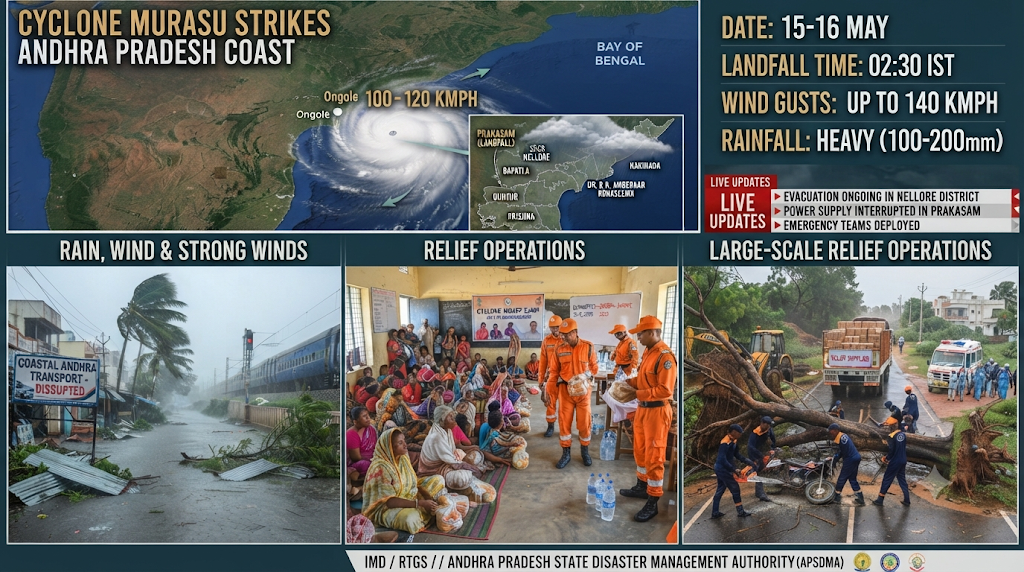
    Cyclone Murasu struck the Andhra Pradesh coast with heavy rain and strong winds, triggering evacuations, transport disruptions and large-scale relief operations across several coastal districts.


    KHABAR 365 NEWS NETOWKR

    AMARAWATI: Cyclone Murasu swept across the Andhra Pradesh coastline on Tuesday, unleashing heavy rain, powerful winds and widespread disruption across several coastal districts. While authorities managed to avert major loss of life through timely evacuations, the storm left behind flooded roads, damaged infrastructure and a trail of destruction in vulnerable areas.

    The severe weather system made landfall near Ongole before moving inland, bringing intense rainfall and gale-force winds that affected normal life across large parts of coastal Andhra Pradesh. Low-lying areas witnessed flooding, while strong winds uprooted trees and damaged property in multiple districts.

    Thousands of residents from vulnerable coastal villages and flood-prone zones were moved to safer locations ahead of the storm. Emergency shelters, disaster response teams and local authorities remained on standby throughout the landfall process to assist affected communities.

    The cyclone caused disruptions to transportation and public services, with flights cancelled, roads blocked and educational institutions closed in several districts. Movement of vehicles was affected in many areas due to waterlogging and poor visibility.

    Fishing communities were among the worst-hit, with rough seas and high waves damaging boats and disrupting livelihoods. Standing crops in some agricultural belts also suffered losses as heavy rainfall and strong winds battered coastal regions.

    As the storm weakened after crossing the coast, authorities launched restoration efforts to clear roads, restore electricity, assess crop damage and provide assistance to affected families. Relief teams continue to monitor vulnerable areas where heavy rainfall and localised flooding remain a concern.

    Officials have urged residents to remain cautious until weather conditions fully improve, warning that waterlogging, weakened structures and fallen trees could continue to pose risks even after the cyclone’s intensity has diminished.

    Why This Matters

    India’s eastern coastline remains highly vulnerable to cyclonic storms, making preparedness and rapid response crucial. Cyclone Murasu once again demonstrated how early warnings, evacuations and coordinated emergency planning can significantly reduce human casualties even during severe weather events.

    365 TAKEAWAY


    Cyclones can no longer be viewed as isolated weather events. With coastal populations growing and weather patterns becoming increasingly unpredictable, resilience is becoming as important as relief. The real success story is not just surviving the storm, but building communities that can withstand the next one.

  • Floods in One State, Drought in Another: The Warning India Cannot Ignore

    Floods in One State, Drought in Another: The Warning India Cannot Ignore

    By Bhavana Pandey


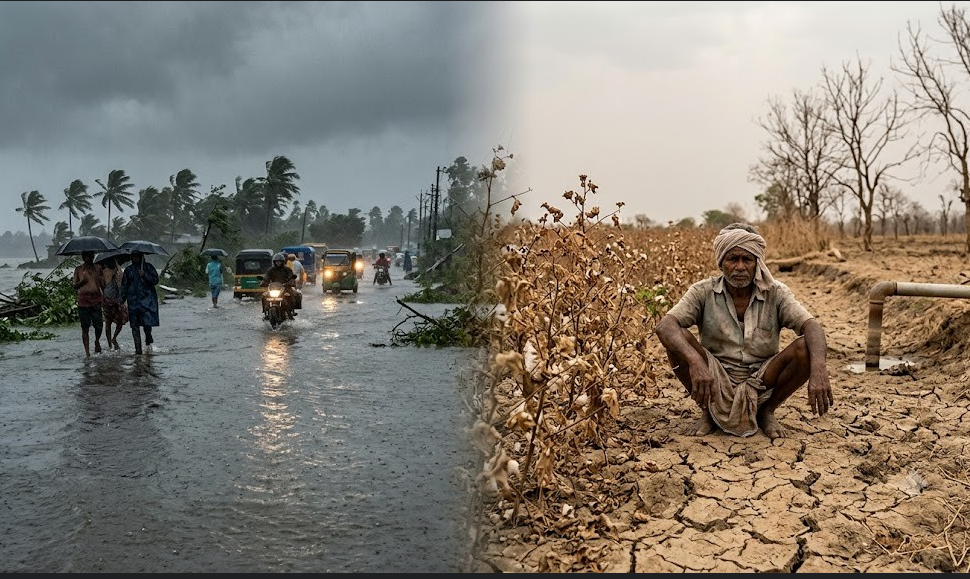
    While Cyclone Arnab has brought heavy rain, strong winds and flooding concerns to eastern India, Telangana has been declared drought-hit. These contrasting developments underscore a deeper challenge facing the country: climate extremes are becoming more frequent, more unpredictable and more costly.


    India today presents a striking contrast.

    In the east, Cyclone Arnab has brought heavy rainfall, strong winds and widespread disruption. In Telangana, farmers and communities are grappling with drought conditions caused by inadequate rainfall and shrinking water resources. One region is struggling with excess water, while another faces an acute shortage.

    At first glance, these appear to be unrelated events. In reality, they are connected by a larger trend that is becoming increasingly visible across the country.

    For generations, India’s economy and society have been shaped by predictable seasonal cycles. Farmers planned sowing patterns around the monsoon. Reservoirs were managed using historical rainfall trends. Cities expanded on the assumption that weather would behave much as it had in the past.

    That assumption no longer holds true.

    Across India, weather is becoming increasingly erratic. Torrential rainfall can occur within a few hours, overwhelming drainage systems and causing floods. At the same time, prolonged dry spells can leave fields parched and reservoirs depleted. Increasingly, the challenge is not simply too much rain or too little rain, but where, when and how that rain falls.

    The consequences go far beyond weather forecasts. Agriculture, water security, food production, public health and infrastructure are all affected. Farmers face uncertainty over crop planning. Cities struggle with waterlogging and traffic paralysis. Rural communities battle falling groundwater levels and crop losses.

    The real concern is that extreme weather events are no longer isolated incidents. They are becoming part of a broader pattern.

    India has made remarkable progress in disaster preparedness. Improved cyclone forecasting and evacuation systems have saved countless lives over the years. However, disaster response alone is no longer sufficient. The country now needs an equally strong focus on adaptation.

    Water conservation must become a national priority. Every district should strengthen rainwater harvesting, watershed development and groundwater recharge projects. Regions that receive excess rainfall should be equipped to store and utilize that water rather than allowing it to flow away.

    Agriculture must adapt to the new reality. Wider adoption of drought-resistant seeds, micro-irrigation systems, climate-resilient farming techniques and scientific weather advisories can help reduce risk for farmers. The future of Indian agriculture will depend not only on productivity but also on resilience.

    Urban India faces an equally urgent challenge. Rapid expansion, shrinking green spaces and inadequate drainage infrastructure have increased vulnerability to flooding. Future city planning must account for extreme rainfall events rather than relying on outdated climate assumptions.

    Technology also offers powerful solutions. Advanced forecasting systems, satellite monitoring, AI-driven weather analysis and real-time disaster alerts can help governments and communities respond more effectively. India already possesses considerable technological capability. The need now is to ensure these tools reach villages, cities and local administrations in a timely manner.

    Most importantly, climate resilience must be viewed not just as an environmental issue but as a development priority. The effects of climate extremes are felt in agriculture, healthcare, infrastructure, education and livelihoods.

    The lesson from today’s headlines is impossible to ignore. Floods in one state and drought in another are not isolated events. They are warning signs of a changing climate reality that demands long-term planning, smarter resource management and greater preparedness.


    365 Takeaway

    Cyclones, floods, droughts and heatwaves are no longer rare disruptions. They are increasingly becoming defining challenges of modern India. The country’s future preparedness will depend not only on how effectively it responds to disasters, but on how intelligently it prepares for them before they occur.


  • Cyclone Arnab Makes Landfall, Heavy Rain and Strong Winds Lash Andhra Coast

    Cyclone Arnab Makes Landfall, Heavy Rain and Strong Winds Lash Andhra Coast

    Cyclone Arnab has made landfall along the Andhra Pradesh coast, bringing heavy rain, strong winds, and widespread disruption across several districts. As the storm moves inland and gradually weakens, weather agencies have warned of continued rainfall and flooding risks in parts of Andhra Pradesh, Odisha, and Chhattisgarh.

    KHABAR365 NEWS NETWORK

    Cyclone Arnab made landfall along the Andhra Pradesh coast on Wednesday, bringing intense rainfall, powerful winds, and widespread disruption in several coastal districts. The cyclonic storm crossed the coast near the Kakinada-Narsapur region and moved inland slowly, prolonging the impact of adverse weather conditions.

    According to weather authorities, the cyclone packed wind speeds of up to 135 km/h, with stronger gusts reported in some locations. Heavy rainfall led to waterlogging in low-lying areas, uprooting of trees, damage to power infrastructure, and interruptions in road, rail, and air services.

    Authorities have maintained high-alert status across affected districts, with emergency response teams deployed to deal with flooding, power outages, and other cyclone-related emergencies. Residents in vulnerable areas were advised to remain cautious as heavy rain continues in the cyclone’s wake.

    Meteorologists expect Cyclone Arnab to gradually weaken as it moves further inland. However, its remnants are likely to bring significant rainfall to parts of Andhra Pradesh, Odisha, and Chhattisgarh over the next couple of days.

    While the strongest winds are expected to weaken after landfall, the risk from heavy rainfall, flooding, and waterlogging remains significant. Residents in affected regions should continue to follow official advisories and avoid unnecessary travel until conditions improve.

error: Content is protected !!