
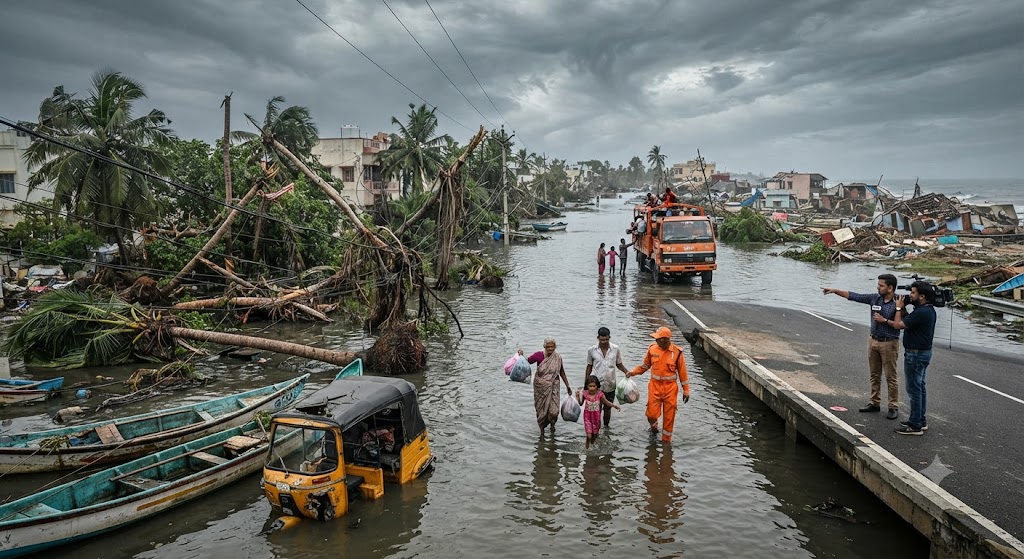
A day after Cyclone Arnab made landfall on the Andhra Pradesh coast, authorities are assessing damage even as heavy rainfall continues to affect parts of eastern and central India. While the cyclone has weakened, its aftermath continues to disrupt daily life, threaten crops and keep disaster response agencies on alert.
KHABAR365 NEWS NETWORK
The immediate threat posed by Cyclone Arnab may have reduced after its landfall on October 28, but the storm’s impact continues to ripple across several states.
Heavy rainfall, strong winds and waterlogging have affected parts of Andhra Pradesh, Odisha, Chhattisgarh, Telangana and adjoining regions, prompting authorities to maintain a high level of preparedness even as the cyclonic system weakens inland.
Initial assessments from Andhra Pradesh indicate damage to homes, power infrastructure and agricultural fields in some of the worst-affected coastal districts. Strong winds uprooted trees, damaged rooftops and disrupted electricity supply in several areas. Large-scale evacuation drives undertaken ahead of landfall helped prevent a greater tragedy and enabled disaster-response teams to begin relief operations soon after conditions improved.
Reports from coastal districts suggest that thousands of residents spent the night in relief shelters as intense rainfall and storm surges battered vulnerable communities. While authorities succeeded in moving large numbers of people to safer locations before the cyclone struck, the focus has now shifted from evacuation to rehabilitation.
In the aftermath of the storm, restoration work is underway across affected regions. Officials are prioritising the clearing of blocked roads, restoration of power supply and delivery of relief materials to affected villages. Disaster management teams are also assessing damage to public infrastructure and standing crops in low-lying areas.
For Chhattisgarh, the story is now more about rainfall than wind. The remnants of the weather system have brought widespread showers across several districts, increasing moisture levels and replenishing reservoirs. However, agricultural experts have cautioned that prolonged waterlogging could damage standing crops and affect harvesting activities in some regions.
The weather system has also coincided with Karwa Chauth celebrations across India. In several cities and towns, families are keeping a close watch on cloud cover and rainfall ahead of the traditional moon-sighting rituals. Despite unsettled weather conditions, festive preparations and market activities have largely continued unabated.
Meteorologists note that cyclones often continue to influence weather patterns long after landfall. Although Arnab has weakened into a lower-pressure system, it still carries significant moisture inland. As a result, authorities have warned of continued rainfall, localised flooding and disruption in vulnerable areas over the coming days.
The coming 48 hours will be crucial as states assess the full scale of damage and work to restore normalcy. For many communities along the coast, the immediate danger may have passed, but the difficult process of recovery has only just begun.
365 Takeaway
Cyclone Arnab may have weakened after landfall, but its impact is far from over. The focus has now shifted from surviving the storm to rebuilding lives, restoring infrastructure and protecting agriculture from the effects of persistent rainfall. How quickly affected regions recover will determine the true cost of the cyclone in the days ahead.