
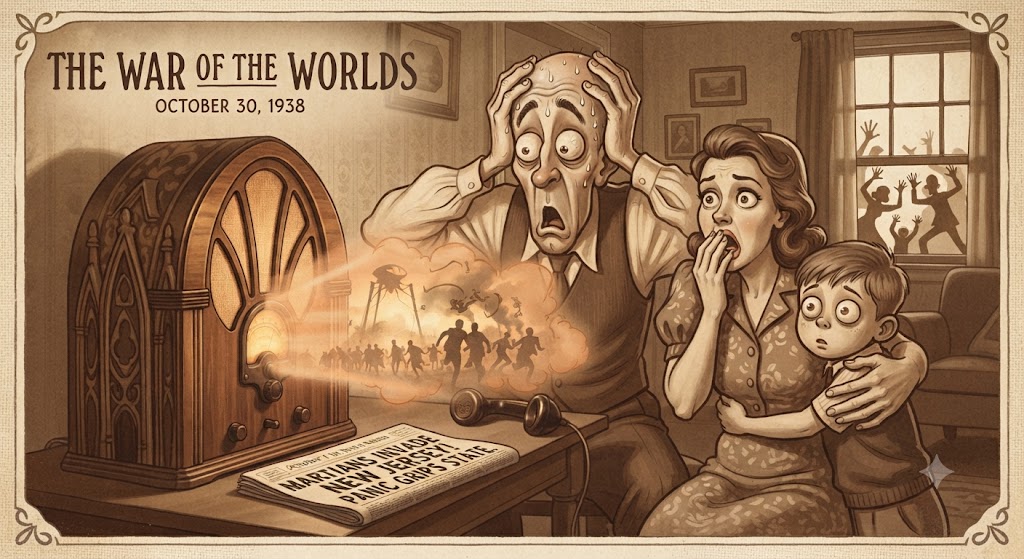
On a chilly October evening in 1938, a routine radio broadcast transformed into one of history’s most astonishing media moments. As “breaking news” reports warned of strange objects falling from the sky and terrifying creatures emerging from them, thousands of listeners believed a Martian invasion had begun. What followed was a night of confusion, fear, and fascination that still serves as a powerful lesson in the age of viral misinformation.
Khabar 365 Offbeat Desk | October 30 Special
What would you do if a breaking news bulletin suddenly announced that aliens had landed on Earth?
Switch on social media? Call friends? Check a news website?
In 1938, none of those options existed.
Yet on the evening of October 30, 1938, panic, confusion, and disbelief spread across parts of the United States when thousands of radio listeners became convinced that Earth was under attack from Mars.
The culprit was not a spaceship.
It was a radio drama.
A young 23-year-old actor and director named Orson Welles had adapted H.G. Wells’ famous science-fiction novel The War of the Worlds for radio. Instead of presenting it as a traditional play, Welles chose a far more daring format. The programme interrupted music broadcasts with increasingly alarming “live news updates” about strange explosions on Mars, a mysterious object crashing in New Jersey, and terrifying creatures emerging from the wreckage.
To listeners tuning in late, it sounded frighteningly real.
The bulletins became more dramatic with every passing minute. Reporters described giant war machines advancing across the countryside. Authorities appeared overwhelmed. The so-called Martians seemed unstoppable.
Some listeners rushed outdoors. Others telephoned police stations, newspapers, and radio networks seeking confirmation. Families gathered around radios in fear, trying to understand whether the unbelievable was actually happening.
Of course, it was all fiction.
But for one extraordinary night, fiction proved powerful enough to compete with reality.
The broadcast instantly became one of the most famous moments in media history. Ironically, historians later argued that reports of nationwide hysteria may themselves have been somewhat exaggerated. Yet the legend only grew stronger over time, turning the programme into a case study in the power of mass communication.
More than eight decades later, the story feels surprisingly modern.
Long before fake news, viral posts, deepfakes and AI-generated content, a simple radio broadcast demonstrated how quickly people can accept dramatic information when it arrives in a believable format. No city was destroyed. No spaceship ever landed. No Martian ever set foot on Earth. Yet the broadcast achieved something remarkable: it invaded the human imagination.
The Martians never came, but for a few unforgettable hours, fear travelled faster than facts.
That is perhaps why the tale continues to fascinate the world today. The technology has changed from crackling radios to smartphones and social media feeds, but the challenge remains exactly the same: separating truth from what merely sounds believable. The greatest alien invasion in history never happened. Its warning, however, may be more relevant today than ever before.
365 Takeaway
Before the internet, before viral posts and long before artificial intelligence entered everyday life, a radio drama demonstrated the extraordinary power of information. The story of the 1938 “Martian invasion” remains a timeless reminder that the more shocking a claim appears, the more important it is to verify it before believing or sharing it.