
Tag: Sustainability

  • Earth’s Ice at the Edge: Scientists Warn the 1.5°C Threshold Could Change the Planet Forever

    Earth’s Ice at the Edge: Scientists Warn the 1.5°C Threshold Could Change the Planet Forever

    AI IMAGE


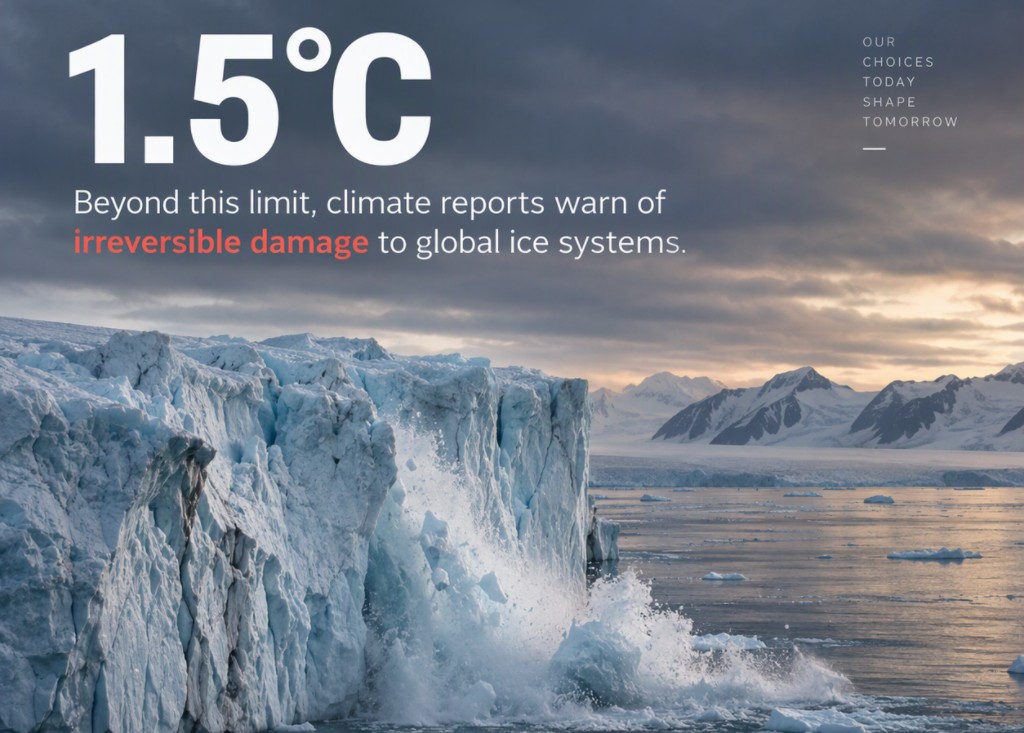
    Scientists warn that crossing the 1.5°C global warming threshold could push glaciers and polar ice systems beyond a point of no return, increasing the risks of sea-level rise, water shortages and long-term climate disruption.


    KAHBAR 365 NEWS NETWORK

    GENEVA: The world’s glaciers, ice sheets and frozen landscapes may be approaching a critical tipping point, with scientists warning that surpassing the 1.5°C global warming threshold could unleash changes that cannot be reversed within human lifetimes.

    For decades, the planet’s frozen regions have functioned as Earth’s natural cooling system, reflecting sunlight, regulating temperatures and storing vast quantities of freshwater. Today, rising temperatures are accelerating the loss of ice from mountain glaciers, the Arctic and Antarctica at a pace that has alarmed climate experts.

    Researchers caution that once certain ice systems begin to destabilise, the process may continue for centuries, even if global temperatures eventually stabilise. The result could be rising sea levels, shrinking freshwater reserves and increasingly unpredictable weather patterns across the globe.

    The consequences extend far beyond environmental concerns. Millions of people depend on glacier-fed rivers for drinking water, agriculture and energy generation. As those frozen reservoirs diminish, pressure on food systems, water security and infrastructure is expected to intensify.

    Scientists say every fraction of a degree now matters. The difference between keeping warming below 1.5°C and exceeding it could determine how much of the world’s ice survives for future generations and how severe the impacts become for coastal communities.

    The warning arrives as nations continue to grapple with the challenge of balancing economic growth, energy demand and climate commitments. Experts argue that the current decade will be decisive in determining the future of glaciers, polar regions and low-lying coastal areas worldwide.

    Why This Matters

    The story of melting ice is no longer about distant glaciers or remote polar landscapes. It is increasingly about the future of cities, agriculture, freshwater supplies and economies. What happens in the world’s frozen regions today will directly influence how future generations live tomorrow.


    365 TAKEAWAY

    The world’s glaciers are often called the planet’s early warning system. Their rapid retreat is a reminder that climate change is no longer a future threat but a present reality. The choices governments, industries and societies make in this decade could determine whether humanity slows the damage or simply learns to live with its consequences.


  • PM Modi Calls for ‘Vocal for Local’, Highlights Science and Sustainability in Mann Ki Baat

    PM Modi Calls for ‘Vocal for Local’, Highlights Science and Sustainability in Mann Ki Baat

    khabhar 365 news network

    New Delhi: Prime Minister Narendra Modi, in the 139th edition of his monthly radio programme Mann Ki Baat, urged citizens to support local artisans and indigenous products during the festive season, saying the “Vocal for Local” movement is helping Indian products gain recognition in global markets.

    Highlighting the growing international reach of Indian products, the Prime Minister noted that Bihar’s makhana is now reaching Greece, while arhar dal from Karnataka is finding markets in the Maldives. He said support for local products not only strengthens livelihoods but also contributes to the vision of a self-reliant India.

    The Prime Minister also drew attention to inspiring success stories from across the country. He praised tribal entrepreneurs in Maharashtra whose products have gained wider recognition through innovative packaging inspired by tribal art and noted the growing popularity of khadi and traditional handicrafts.

    In a tribute to Indian scientific excellence, Narendra Modi remembered Narinder Singh Kapany, widely known as the “Father of Fiber Optics,” ahead of his 100th birth anniversary. He remarked that the modern era of internet and digital communication would be difficult to imagine without Kapany’s pioneering work in fiber-optic technology.

    The programme also highlighted India’s progress in digital healthcare. The Prime Minister noted that the e-Sanjeevani telemedicine platform has crossed 50 crore consultations, making healthcare services more accessible, particularly in remote regions.

    On the environmental front, he referred to the revival of the Heval River in Uttarakhand through community participation, rainwater harvesting and large-scale plantation drives, calling it an inspiring example of collective action.

    The Prime Minister also highlighted organic cotton cultivation and traditional weaving initiatives in Punjab, as well as renewed efforts to promote millet cultivation in the Northeast, underlining the importance of sustainable agriculture and local innovation.

    Marking 12 years of Mann Ki Baat, Narendra Modi described the programme as a “pilgrimage” that enables him to learn from and celebrate the achievements of ordinary citizens across the country.

    365 Takeaway

    Support local, embrace innovation and celebrate those making a difference. India’s success stories are being written not just in laboratories and boardrooms, but in villages, workshops, farms and communities across the country.

error: Content is protected !!